Removal, trimming, storm cleanup, and stump grinding across Goldsboro and Wayne County. Written estimates before the work starts.
Call (555) 555-5555Or call — we answer. No obligation, honest advice.
Wayne County knows what water does to trees. Floyd, Matthew, Florence - most people here have a hurricane story, and a striking number of those stories are really about the ground rather than the wind. When the Neuse and the Little River come up and the soil goes to saturation, root plates lose their grip, and trees that would have stood through the same gusts on dry ground simply lean over and keep going. That is the difference between this county and places where trees mostly snap.
The county's tree stock tells its own history. Older in-town blocks carry mature oaks and pecans that have been shading those streets for generations. Former farmland has grown up in fast pine stands with the shallow root systems that come with growing quickly. And along the riverbottoms there are hardwoods sitting in ground that softens every wet year. Those three situations need different judgment, and treating them the same is how people get surprised.
The approach is straightforward. Look at the tree, tell you honestly what it needs, put the estimate in writing, and do the work when we said we would. Cleanup and haul-off are in the removal quote from the start. And if the honest answer is that the tree is sound and you should keep your money, that is the answer you will get.
In tight quarters, tree work is rigging work. Pieces come off in a planned order and get lowered under control rather than dropped and hoped, because between a house and a fence there is no room for a piece to go where it wants. That planning is most of the job and all of the difference.
The site gets raked before we leave. On saturated ground there is a second consideration: heavy equipment leaves ruts in soft soil, so timing and matting matter, and a yard that has just been through a wet stretch deserves more care rather than less.
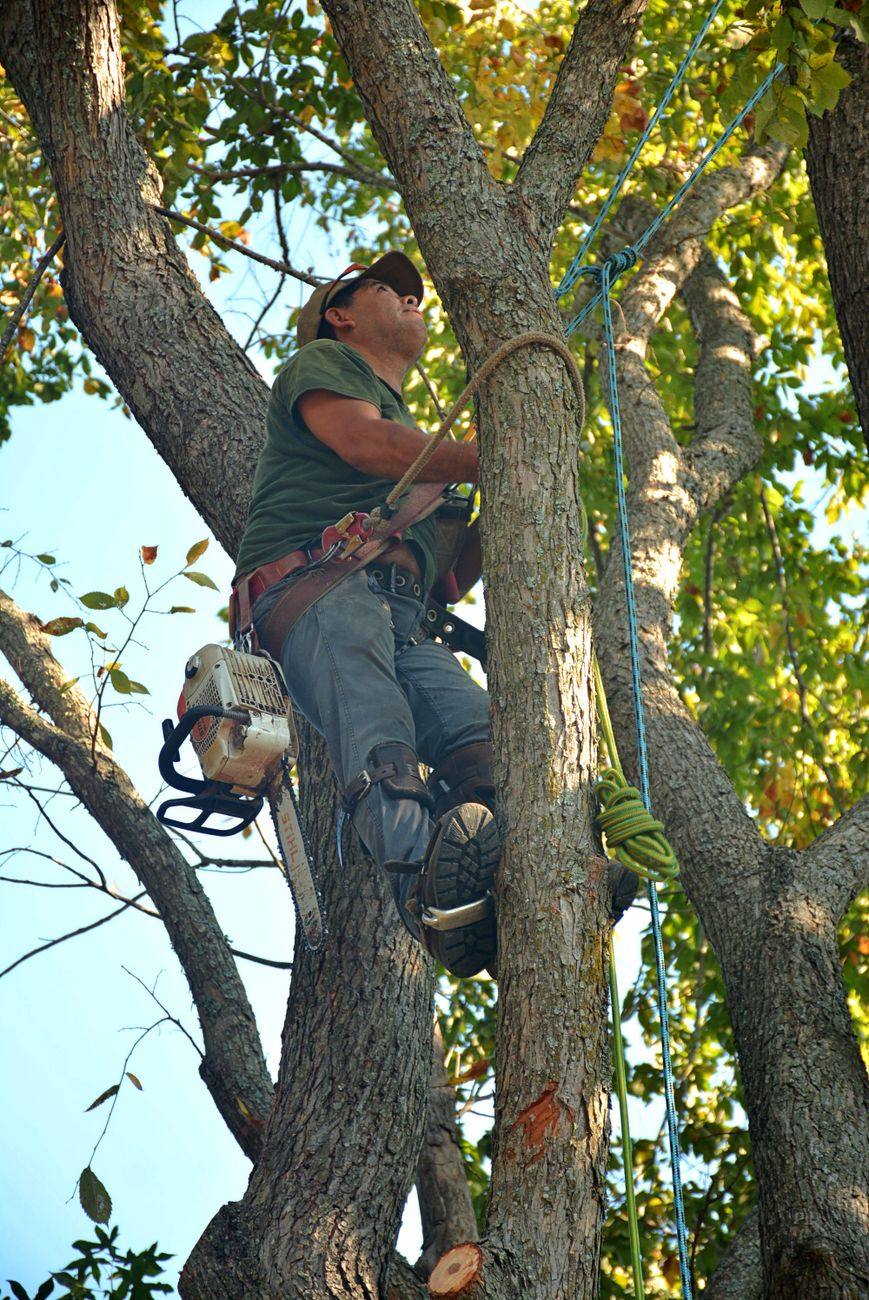
Removal, trimming, and stump grinding cover most of what a Wayne County property needs, with storm response when the river and the wind make the decision for you.
Dead, damaged, leaning, and storm-hit trees taken down safely, including technical removals in tight quarters. Cleanup and haul-off included in the quote.
Deadwood, clearance over roofs and drives, and structural work on younger trees. Cuts placed at the branch collar so the wound can seal.
Stumps ground below grade so the spot can be sodded, planted, or simply mowed across without steering around it.
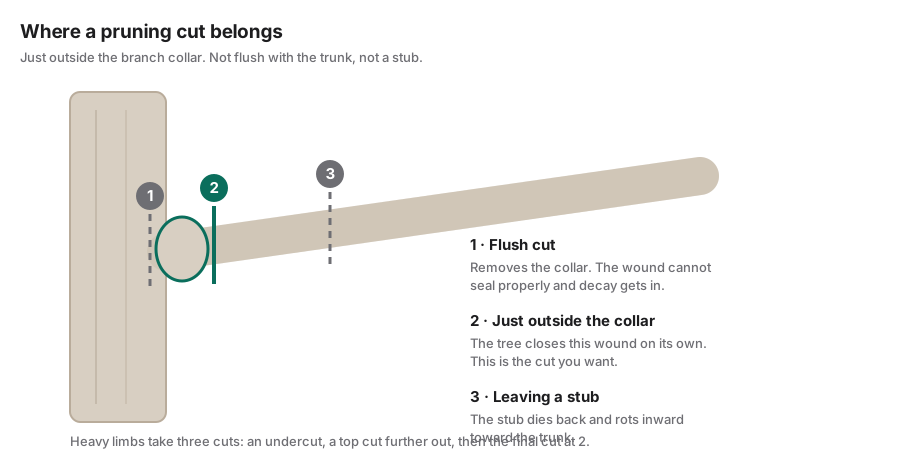
The single most consequential detail in pruning is where the blade lands. Every limb has a slightly raised ring at its base - the branch collar - and that ring holds the tissue the tree relies on to close a wound. A cut placed just outside it lets the tree seal itself over the following seasons without help.
Take the collar off along with the limb and the tree loses the ability to close that opening; decay then works inward through the trunk. Go the other way and leave a stub, and the stub dies back and rots toward the trunk anyway. Neither mistake announces itself for a few years, which is why so much bad pruning goes unnoticed until the damage is done.
For anything heavy there is a further rule: three cuts, not one. Undercut first, then a top cut further out to take the weight off, then the finish cut at the collar. A heavy limb cut in one pass tears loose before the saw is through and strips bark down the trunk as it falls.
The thing worth understanding about trees in this county is that the same tree is not equally safe in every season. A root plate holds a tree up by gripping soil, and soil that has been saturated for a week grips considerably less. That is why storms here uproot trees that stood through worse wind in a dry August, and why the tree to worry about is often the one on ground that stays wet.
Pines on old farmland are their own case. They grow fast, which is good for shade and bad for anchorage, and a stand that went up together tends to come down together once one of them opens a gap for the wind. The mature oaks and pecans in older neighborhoods usually fail by dropping limbs rather than uprooting, and those limbs are typically ones that had been dead for a while. Riverbottom hardwoods are the ones that quietly soften year after wet year.
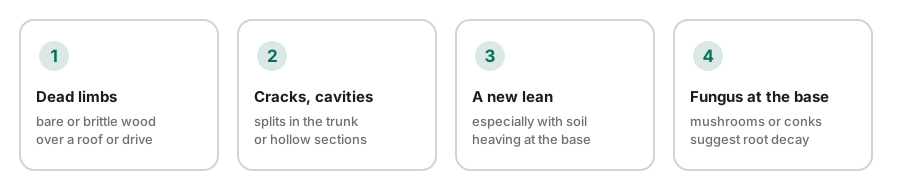
Most failures give notice. Dead limbs stay up in the canopy for seasons. Cracks and cavities open slowly. A lean develops, and the tell is not the lean itself but soil heaving or cracking on the opposite side of the trunk, which means the root plate has started to move. Mushrooms or shelf fungus at the base suggest the roots are decaying even when the canopy still looks fine. None of these are automatic death sentences, and a calm-weather look costs nothing.
Two habits do real harm around here. Topping a tree - cutting the crown back to stubs - forces weak regrowth from every wound and produces a more dangerous tree within a few years. And piling soil or mulch against a trunk keeps bark constantly damp, which invites the rot that later shows up as a base problem nobody can explain.
None of these mean a tree has to come down. All of them are worth honest eyes before the next wet stretch rather than after.
Every job runs the same way, whether it is one limb over a carport or a pine stand behind the house.
Somebody looks at the actual tree and puts the number in writing, with cleanup and haul-off included rather than added later.
Seymour Johnson keeps this town moving, and PCS timelines do not negotiate. Tell us the move-out date, the rental turnover, or the inspection, and we will tell you honestly whether we can hit it.
For storm work you get photographs and an itemized written scope - the documentation an insurance adjuster can actually process rather than a number scrawled on a card.
When a named storm puts the Neuse over its banks, the tree work that follows has a predictable shape, and knowing it in advance saves people money and trouble.
First, priorities. Anything on a house, a vehicle, or a power line comes first, and anything in contact with a power line is a utility call before it is a tree call - not something for a homeowner or a crew to go near. A large tree lying across an open yard looks dramatic and is genuinely one of the least urgent things on the list. Second, documentation. Photograph the damage before anything is moved, keep the written scope and the invoice together, and give your adjuster an itemized description rather than a lump sum, because that is what gets processed without a second round of questions.
Third, and this is the one that costs people real money: after every hurricane, out-of-county crews arrive with trucks and cash-only offers, knock on doors, and ask for money up front. Some are fine. Many are not, and the ones that vanish take deposits with them. The protections are simple and worth applying to anyone, including us - get it in writing before work starts, do not pay a large deposit up front, and ask for a certificate of insurance sent directly from the insurer rather than handed over as a photocopy. Tree work is dangerous enough that uninsured crews on your property become your exposure, not theirs.
Goldsboro is the base, and the service area covers Wayne County and its edges - Pikeville, Fremont, Mount Olive, Dudley, Grantham, Rosewood, Walnut Creek, Seven Springs, Eureka, and Elroy. In town that means the mature canopies of the older blocks; outside it means pine stands on former farmland and the hardwood bottoms along the Neuse and the Little River.
Travel time is part of the quote on the far edges, and we will tell you that on the phone rather than adding it to the invoice afterward. If you are just outside the list below, it is still worth calling.

A base town runs on deadlines other places do not have. Orders arrive, a move-out date lands, and suddenly the overgrown limb over the driveway or the dead tree the landlord mentioned has to be handled inside a fixed window. Rental turnovers and housing inspections work the same way: the work is not complicated, but the date is not flexible.
The useful thing we can offer is a straight answer about timing. Tell us the deadline when you call and we will say plainly whether it is achievable, rather than booking it and letting you discover the problem the week of. If it is not achievable we will say that too, which is more useful than a maybe.
One note for anyone arriving from a drier part of the country: trees behave differently here than they do in the mountain west or the southwest. Fast growth, wet ground, and hurricane season combine into a maintenance rhythm that catches new residents off guard, and the tree that came with the house has usually had less attention than it looks like it has had.
Estimates are free and in writing. Removal pricing follows size, species, and above all access - a pine that can be dropped whole in an open field is a different job from the same pine between a house and a fence, which is why an honest number comes from looking rather than from a phone description. Trimming prices by scope, stump grinding by diameter and count.
Call (555) 555-5555 for removal, trimming, storm cleanup, or stump grinding anywhere in Goldsboro and Wayne County. February is the cheapest month to deal with a limb you have been watching since September.
Tell us what you need and we'll get back to you with a real answer. If it's an active backup or standing water over the field, calling gets you a faster response.
Call: (555) 555-5555
Area: Goldsboro, NC and Wayne County